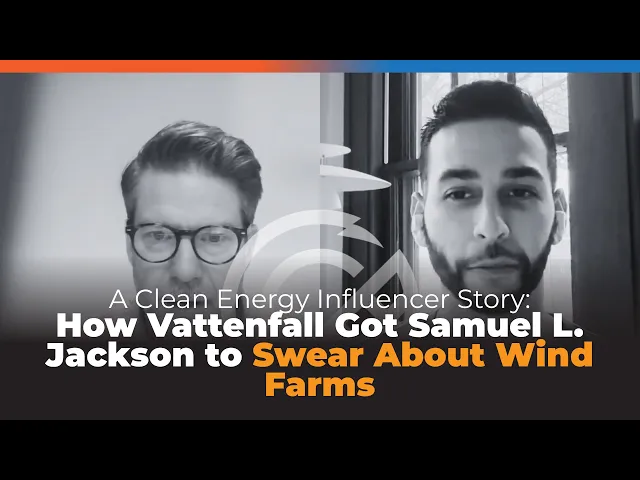
How Vattenfall Got Samuel L. Jackson to Swear About Wind Farms
Safe is the riskiest thing an energy brand can do.
Paul Morel, Former Head of Brand Activation said it plainly, and it's one of the most useful statements in the whole session in my opinion: people don't care about energy companies (utilities). Not really. They care when the bill arrives, and then they forget you exist.
So if you want people to talk about you, you have to do things that not everyone will like, seriously. Vattenfall found an insight that most brands would likely have run away from: people were cursing about wind farms. Loud, ugly, harmful to nature. Instead of defending against it, they leaned all the way in and put those exact words in the mouth of the one person alive who could say them and make it feel real.
Samuel L. Jackson calling them "motherf***ing wind farms" was the result…
Absolutely insanely impactful.
"We need to do stuff that everyone doesn't like, because that's what you need to do if you're an energy company and if you're not Nike."
Fame Doesn't Always Mean Famous People
This was my favorite reframe of the session. When Paul says "fame," he doesn't mean celebrities. He means making people talk about Vattenfall when Vattenfall isn't in the room.
A famous person is just one way to do that, because you get to piggyback on the fame they already have. What Paul actually wanted was the reaction: an energy company in Northern Europe collaborating with Samuel L. Jackson, what is that even about? He called it "unreasonable for reasonable reasons."
And he was honest that not all of the reactions were positive, and that you have to prepare your management to sit calmly while their feed lights up.
You Couldn't Have Done This Five Years Ago
The bold ad is the easy part to admire from my lens. The hard part is that the same pitch would have been impossible at Vattenfall five years earlier.
When he brought it to the CEO, she laughed and approved it. Easy sell. But that "easy" was paid for over three to four years of doing unglamorous work of everything a marketer in our industry is tasked with doing and then some to build good political capital within their respective organization.
Without this baked in to Paul's long-term strategy, the meeting with the CEO would have been a debate about whether a 100% state-owned energy company full of engineers can swear in a commercial.
"We would not have been able to do this five years ago." The campaign didn't earn the trust. Instead, the years of boring proof earned the trust, and the trust earned the campaign."
How He Proved It Was Worth It
Naturally, someone asked the ROI question, because brand awareness is the hardest thing to defend with a number.
Paul keeps it close to math. The fee for Samuel (far below his usual rate, by the way, because he liked it and wanted to do it) cost roughly the same as a six to eight week national campaign in Sweden alone. For that, Vattenfall got 500 million plus in reach and PR effects in 22 countries (with additional paid media support), while only actively operating in 10 markets, which is the most efficient investment in reach they'd ever made.
Up the chain, he reports three KPIs: consideration (how attractive is the brand, not just to buyers but to talent, partners, and influential people), reputation, and brand finance (how much equity in dollars and cents sits in the brand). Everything else in the funnel, the team tracks themselves.
Zero to One
A lot of us in clean energy B2B aren't sitting on a Samuel L. Jackson budget. We're at zero, trying to get to one. So I asked him how.
His answer was refreshingly unmagical. Build your strategy on scientifically proven theory, then measure, do, follow up, measure, do, follow up, and watch the KPIs move. That's how you build trust, build a business case, and earn the bigger media funds later. Vattenfall leans on the long-and-short work from Peter Field and System1, and listens closely to Mark Ritson on brand management through the funnel.
"There's no magic to it at all," he said. "Find your method, build your strategy, and run it consistently over time. The flashy campaign is just what becomes possible once the boring discipline is already in place."
Jacob Yang
Founder of Amp Your Story | The Clean Energy Marketer
How Vattenfall Got Samuel L. Jackson to Swear About Wind Farms
Safe is the riskiest thing an energy brand can do.
Paul Morel, Former Head of Brand Activation said it plainly, and it's one of the most useful statements in the whole session in my opinion: people don't care about energy companies (utilities). Not really. They care when the bill arrives, and then they forget you exist.
So if you want people to talk about you, you have to do things that not everyone will like, seriously. Vattenfall found an insight that most brands would likely have run away from: people were cursing about wind farms. Loud, ugly, harmful to nature. Instead of defending against it, they leaned all the way in and put those exact words in the mouth of the one person alive who could say them and make it feel real.
Samuel L. Jackson calling them "motherf***ing wind farms" was the result…
Absolutely insanely impactful.
"We need to do stuff that everyone doesn't like, because that's what you need to do if you're an energy company and if you're not Nike."
Fame Doesn't Always Mean Famous People
This was my favorite reframe of the session. When Paul says "fame," he doesn't mean celebrities. He means making people talk about Vattenfall when Vattenfall isn't in the room.
A famous person is just one way to do that, because you get to piggyback on the fame they already have. What Paul actually wanted was the reaction: an energy company in Northern Europe collaborating with Samuel L. Jackson, what is that even about? He called it "unreasonable for reasonable reasons."
And he was honest that not all of the reactions were positive, and that you have to prepare your management to sit calmly while their feed lights up.
You Couldn't Have Done This Five Years Ago
The bold ad is the easy part to admire from my lens. The hard part is that the same pitch would have been impossible at Vattenfall five years earlier.
When he brought it to the CEO, she laughed and approved it. Easy sell. But that "easy" was paid for over three to four years of doing unglamorous work of everything a marketer in our industry is tasked with doing and then some to build good political capital within their respective organization.
Without this baked in to Paul's long-term strategy, the meeting with the CEO would have been a debate about whether a 100% state-owned energy company full of engineers can swear in a commercial.
"We would not have been able to do this five years ago." The campaign didn't earn the trust. Instead, the years of boring proof earned the trust, and the trust earned the campaign."
How He Proved It Was Worth It
Naturally, someone asked the ROI question, because brand awareness is the hardest thing to defend with a number.
Paul keeps it close to math. The fee for Samuel (far below his usual rate, by the way, because he liked it and wanted to do it) cost roughly the same as a six to eight week national campaign in Sweden alone. For that, Vattenfall got 500 million plus in reach and PR effects in 22 countries (with additional paid media support), while only actively operating in 10 markets, which is the most efficient investment in reach they'd ever made.
Up the chain, he reports three KPIs: consideration (how attractive is the brand, not just to buyers but to talent, partners, and influential people), reputation, and brand finance (how much equity in dollars and cents sits in the brand). Everything else in the funnel, the team tracks themselves.
Zero to One
A lot of us in clean energy B2B aren't sitting on a Samuel L. Jackson budget. We're at zero, trying to get to one. So I asked him how.
His answer was refreshingly unmagical. Build your strategy on scientifically proven theory, then measure, do, follow up, measure, do, follow up, and watch the KPIs move. That's how you build trust, build a business case, and earn the bigger media funds later. Vattenfall leans on the long-and-short work from Peter Field and System1, and listens closely to Mark Ritson on brand management through the funnel.
"There's no magic to it at all," he said. "Find your method, build your strategy, and run it consistently over time. The flashy campaign is just what becomes possible once the boring discipline is already in place."
Jacob Yang
Founder of Amp Your Story | The Clean Energy Marketer
How Vattenfall Got Samuel L. Jackson to Swear About Wind Farms
Safe is the riskiest thing an energy brand can do.
Paul Morel, Former Head of Brand Activation said it plainly, and it's one of the most useful statements in the whole session in my opinion: people don't care about energy companies (utilities). Not really. They care when the bill arrives, and then they forget you exist.
So if you want people to talk about you, you have to do things that not everyone will like, seriously. Vattenfall found an insight that most brands would likely have run away from: people were cursing about wind farms. Loud, ugly, harmful to nature. Instead of defending against it, they leaned all the way in and put those exact words in the mouth of the one person alive who could say them and make it feel real.
Samuel L. Jackson calling them "motherf***ing wind farms" was the result…
Absolutely insanely impactful.
"We need to do stuff that everyone doesn't like, because that's what you need to do if you're an energy company and if you're not Nike."
Fame Doesn't Always Mean Famous People
This was my favorite reframe of the session. When Paul says "fame," he doesn't mean celebrities. He means making people talk about Vattenfall when Vattenfall isn't in the room.
A famous person is just one way to do that, because you get to piggyback on the fame they already have. What Paul actually wanted was the reaction: an energy company in Northern Europe collaborating with Samuel L. Jackson, what is that even about? He called it "unreasonable for reasonable reasons."
And he was honest that not all of the reactions were positive, and that you have to prepare your management to sit calmly while their feed lights up.
You Couldn't Have Done This Five Years Ago
The bold ad is the easy part to admire from my lens. The hard part is that the same pitch would have been impossible at Vattenfall five years earlier.
When he brought it to the CEO, she laughed and approved it. Easy sell. But that "easy" was paid for over three to four years of doing unglamorous work of everything a marketer in our industry is tasked with doing and then some to build good political capital within their respective organization.
Without this baked in to Paul's long-term strategy, the meeting with the CEO would have been a debate about whether a 100% state-owned energy company full of engineers can swear in a commercial.
"We would not have been able to do this five years ago." The campaign didn't earn the trust. Instead, the years of boring proof earned the trust, and the trust earned the campaign."
How He Proved It Was Worth It
Naturally, someone asked the ROI question, because brand awareness is the hardest thing to defend with a number.
Paul keeps it close to math. The fee for Samuel (far below his usual rate, by the way, because he liked it and wanted to do it) cost roughly the same as a six to eight week national campaign in Sweden alone. For that, Vattenfall got 500 million plus in reach and PR effects in 22 countries (with additional paid media support), while only actively operating in 10 markets, which is the most efficient investment in reach they'd ever made.
Up the chain, he reports three KPIs: consideration (how attractive is the brand, not just to buyers but to talent, partners, and influential people), reputation, and brand finance (how much equity in dollars and cents sits in the brand). Everything else in the funnel, the team tracks themselves.
Zero to One
A lot of us in clean energy B2B aren't sitting on a Samuel L. Jackson budget. We're at zero, trying to get to one. So I asked him how.
His answer was refreshingly unmagical. Build your strategy on scientifically proven theory, then measure, do, follow up, measure, do, follow up, and watch the KPIs move. That's how you build trust, build a business case, and earn the bigger media funds later. Vattenfall leans on the long-and-short work from Peter Field and System1, and listens closely to Mark Ritson on brand management through the funnel.
"There's no magic to it at all," he said. "Find your method, build your strategy, and run it consistently over time. The flashy campaign is just what becomes possible once the boring discipline is already in place."
Jacob Yang
Founder of Amp Your Story | The Clean Energy Marketer