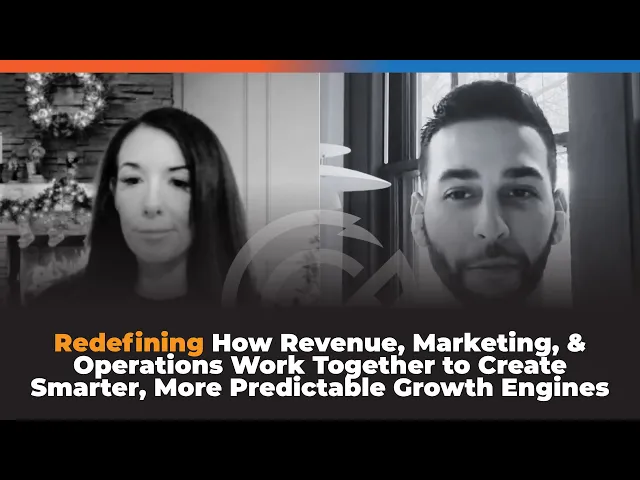
Redefining How Revenue, Marketing, & Operations Work Together to Create Smarter, More Predictable Growth Engines (Clean Energy)
Campaigns don't fail. Handoffs do.
That's the line that's been with me since I recorded the second Amp Your Story speaker session with Amanda Price. Amanda is a RevOps and Marketing Leader whose career runs across many industries, including clean energy: sustainability programs for Fortune 500s, C&I customers, solar developers, Salesforce partner work, C&I financing, and more.
What I'm going to share is the framework she walked me through. If you'd rather watch, the video is up too (see below).
RevOps Is Flow, Not Function
Amanda's working definition: RevOps is the through-line that connects marketing, business development, estimating, operations, customer success, and back around again. The departments don't change, but rather, the relationships between them do.
An older version of revenue operations focused on each function in isolation. Was marketing hitting its number? Was BD? Was ops? Everything got optimized by function and described by function, and the seams between functions were where the work fell through.
Amanda's version replaces that with one cohesive system. Same conversations, same dialogue, same language across departments. A system you build and not simply another meeting on the calendar.
Her line on this: "You can't scale what you can't explain."
Clean energy companies want measurable growth (25% next year, say), but sometimes, they don't actually know where their critical risk factors are, where the bottlenecks sit, and where the friction points hide. This leads to the growth target compounding the problem. Front-end marketing and BD pull more deals in. Back-end execution falls further behind. Projects derail. Client relationships hurt. Yikes.
Why Clean Energy Needs This Now
Amanda thinks every industry needs a dedicated RevOps leader, especially clean energy.
The reason: we're scaling faster than we're internally maturing. And that gap is expensive.
Look at the 2030 grid readiness numbers. Solar, wind, storage all have to deliver to support the plan. And we're doing that against long sales cycles that recently got longer (IRA acceleration in August, the IRS notice on beginning-of-construction dates), thinner margins, capital pressure, complex stakeholder chains, and ongoing policy and regulatory risk.
If your company isn't optimizing internally for all of that, the rest of the industry will grow without you. Amanda's framing: the energy space is going to grow regardless. The question is whether you grow with it!
Why Is the Handoff Is the Real Problem?
Most clean energy marketing orgs report by function. Marketing says: we're winning, we're delivering MQLs. BD says: marketing's leads aren't converting. Both teams are doing the work they've defined as theirs. The handoff between them is where the value evaporates.
Amanda runs both marketing and RevOps, so she sees this from both seats. Her test for whether marketing is doing its job is whether the leads convert to revenue. If they don't, she's not telling herself the MQL count is the win. She's saying she made art.
Her exact line: "If I do something in marketing and it's not generating revenue, I've created art. Good job. Congrats. It looks pretty. It looks great. That's not the game."
The game is revenue and conversion. Which means marketing has to talk with BD and sales. Brand messaging has to match what's getting said on calls. Attribution has to connect back to the opportunity in the CRM, not float somewhere upstream as a marketing-only metric.
Marketing Belongs Inside the Revenue Process
A common worry Amanda hears: if marketing gets pulled into RevOps and measured on revenue contribution, the creative side dies.
Her view, as a working marketer herself: honestly, not even close. Knowing what's working and what's not doesn't hinder her creativity. It tells her where to spend it. True downstream attribution lets her bring the story at the end of the funnel back to the top and filter it back through again.
The argument that RevOps kills marketing usually comes from marketers who haven't tried it. The ones who have, like Amanda, find the opposite.
AI Is a Diagnostic Tool, Not a Moral Compass
Amanda's framing on AI in RevOps is one of the sharpest takes I've heard.
What AI is good at: pattern recognition, lag detection, surfacing misalignment between departments faster than a human can. It can tell you when teams aren't talking. It can flag handoff breakdowns.
What it isn't good at: making them talk. Making the call. Carrying accountability. Replacing trust. And here she got emphatic. Safety decisions are off the table. Never up for question. Don't use AI to accelerate a process if accelerating that process puts somebody at risk. (She said this twice, on purpose.)
The other line worth repeating here! "AI accelerates truth." Which sounds great until you remember that bad data accelerates the truth of bad data. If your CRM is a mess, AI just gives you confident wrong answers faster.
Plan. Analyze. Align. Execute.
Amanda's working loop, in order, every time.
Plan what you're going to do. Analyze (talk to people, talk to departments, look at the reports, get the actual ground truth). Get alignment that what you're seeing and what they're telling you holds up. Then execute.
And then go back and do it again. Because what you thought would fix the issue often doesn't fix it completely. She compared it to ironing. You don't get the wrinkles out on the first pass. You go slow, with steam, with pressure, a few times. Same for fixing a broken process.
It is, on its face, a boring framework. That's the point. Most teams just skip the analyze and align steps because they're slow, and then wonder why their execution doesn't land.
Each Department Owns a Number
To get real accountability, each department needs to own a number tied to the revenue process. They need to back it up. It sounds harsh. Amanda's view is that it's just the reality.
"Pointing out the problems is not the real issue. The issue is getting people to actually implement change and to care about the change."
What This All Adds up to in RevOps
RevOps in clean energy is really just a truth function. The job is uncovering where time and revenue are leaking, smoothing those out, and giving the C-suite and the board the kind of stability they need to plan against. (And boards, as Amanda put it, will take bad news. They just won't tolerate surprises.)
Two stakes worth naming. One is internal: clean energy companies that don't get this right will spend the next decade burning money on growth they can't actually execute against. The other is external: the 2030 buildout doesn't happen on schedule if the companies building it can't keep their internal handoffs together.
Resilient systems for a resilient future. That's the work.
Jacob Yang
Founder of Amp Your Story | The Clean Energy Marketer
Redefining How Revenue, Marketing, & Operations Work Together to Create Smarter, More Predictable Growth Engines (Clean Energy)
Campaigns don't fail. Handoffs do.
That's the line that's been with me since I recorded the second Amp Your Story speaker session with Amanda Price. Amanda is a RevOps and Marketing Leader whose career runs across many industries, including clean energy: sustainability programs for Fortune 500s, C&I customers, solar developers, Salesforce partner work, C&I financing, and more.
What I'm going to share is the framework she walked me through. If you'd rather watch, the video is up too (see below).
RevOps Is Flow, Not Function
Amanda's working definition: RevOps is the through-line that connects marketing, business development, estimating, operations, customer success, and back around again. The departments don't change, but rather, the relationships between them do.
An older version of revenue operations focused on each function in isolation. Was marketing hitting its number? Was BD? Was ops? Everything got optimized by function and described by function, and the seams between functions were where the work fell through.
Amanda's version replaces that with one cohesive system. Same conversations, same dialogue, same language across departments. A system you build and not simply another meeting on the calendar.
Her line on this: "You can't scale what you can't explain."
Clean energy companies want measurable growth (25% next year, say), but sometimes, they don't actually know where their critical risk factors are, where the bottlenecks sit, and where the friction points hide. This leads to the growth target compounding the problem. Front-end marketing and BD pull more deals in. Back-end execution falls further behind. Projects derail. Client relationships hurt. Yikes.
Why Clean Energy Needs This Now
Amanda thinks every industry needs a dedicated RevOps leader, especially clean energy.
The reason: we're scaling faster than we're internally maturing. And that gap is expensive.
Look at the 2030 grid readiness numbers. Solar, wind, storage all have to deliver to support the plan. And we're doing that against long sales cycles that recently got longer (IRA acceleration in August, the IRS notice on beginning-of-construction dates), thinner margins, capital pressure, complex stakeholder chains, and ongoing policy and regulatory risk.
If your company isn't optimizing internally for all of that, the rest of the industry will grow without you. Amanda's framing: the energy space is going to grow regardless. The question is whether you grow with it!
Why Is the Handoff Is the Real Problem?
Most clean energy marketing orgs report by function. Marketing says: we're winning, we're delivering MQLs. BD says: marketing's leads aren't converting. Both teams are doing the work they've defined as theirs. The handoff between them is where the value evaporates.
Amanda runs both marketing and RevOps, so she sees this from both seats. Her test for whether marketing is doing its job is whether the leads convert to revenue. If they don't, she's not telling herself the MQL count is the win. She's saying she made art.
Her exact line: "If I do something in marketing and it's not generating revenue, I've created art. Good job. Congrats. It looks pretty. It looks great. That's not the game."
The game is revenue and conversion. Which means marketing has to talk with BD and sales. Brand messaging has to match what's getting said on calls. Attribution has to connect back to the opportunity in the CRM, not float somewhere upstream as a marketing-only metric.
Marketing Belongs Inside the Revenue Process
A common worry Amanda hears: if marketing gets pulled into RevOps and measured on revenue contribution, the creative side dies.
Her view, as a working marketer herself: honestly, not even close. Knowing what's working and what's not doesn't hinder her creativity. It tells her where to spend it. True downstream attribution lets her bring the story at the end of the funnel back to the top and filter it back through again.
The argument that RevOps kills marketing usually comes from marketers who haven't tried it. The ones who have, like Amanda, find the opposite.
AI Is a Diagnostic Tool, Not a Moral Compass
Amanda's framing on AI in RevOps is one of the sharpest takes I've heard.
What AI is good at: pattern recognition, lag detection, surfacing misalignment between departments faster than a human can. It can tell you when teams aren't talking. It can flag handoff breakdowns.
What it isn't good at: making them talk. Making the call. Carrying accountability. Replacing trust. And here she got emphatic. Safety decisions are off the table. Never up for question. Don't use AI to accelerate a process if accelerating that process puts somebody at risk. (She said this twice, on purpose.)
The other line worth repeating here! "AI accelerates truth." Which sounds great until you remember that bad data accelerates the truth of bad data. If your CRM is a mess, AI just gives you confident wrong answers faster.
Plan. Analyze. Align. Execute.
Amanda's working loop, in order, every time.
Plan what you're going to do. Analyze (talk to people, talk to departments, look at the reports, get the actual ground truth). Get alignment that what you're seeing and what they're telling you holds up. Then execute.
And then go back and do it again. Because what you thought would fix the issue often doesn't fix it completely. She compared it to ironing. You don't get the wrinkles out on the first pass. You go slow, with steam, with pressure, a few times. Same for fixing a broken process.
It is, on its face, a boring framework. That's the point. Most teams just skip the analyze and align steps because they're slow, and then wonder why their execution doesn't land.
Each Department Owns a Number
To get real accountability, each department needs to own a number tied to the revenue process. They need to back it up. It sounds harsh. Amanda's view is that it's just the reality.
"Pointing out the problems is not the real issue. The issue is getting people to actually implement change and to care about the change."
What This All Adds up to in RevOps
RevOps in clean energy is really just a truth function. The job is uncovering where time and revenue are leaking, smoothing those out, and giving the C-suite and the board the kind of stability they need to plan against. (And boards, as Amanda put it, will take bad news. They just won't tolerate surprises.)
Two stakes worth naming. One is internal: clean energy companies that don't get this right will spend the next decade burning money on growth they can't actually execute against. The other is external: the 2030 buildout doesn't happen on schedule if the companies building it can't keep their internal handoffs together.
Resilient systems for a resilient future. That's the work.
Jacob Yang
Founder of Amp Your Story | The Clean Energy Marketer
Redefining How Revenue, Marketing, & Operations Work Together to Create Smarter, More Predictable Growth Engines (Clean Energy)
Campaigns don't fail. Handoffs do.
That's the line that's been with me since I recorded the second Amp Your Story speaker session with Amanda Price. Amanda is a RevOps and Marketing Leader whose career runs across many industries, including clean energy: sustainability programs for Fortune 500s, C&I customers, solar developers, Salesforce partner work, C&I financing, and more.
What I'm going to share is the framework she walked me through. If you'd rather watch, the video is up too (see below).
RevOps Is Flow, Not Function
Amanda's working definition: RevOps is the through-line that connects marketing, business development, estimating, operations, customer success, and back around again. The departments don't change, but rather, the relationships between them do.
An older version of revenue operations focused on each function in isolation. Was marketing hitting its number? Was BD? Was ops? Everything got optimized by function and described by function, and the seams between functions were where the work fell through.
Amanda's version replaces that with one cohesive system. Same conversations, same dialogue, same language across departments. A system you build and not simply another meeting on the calendar.
Her line on this: "You can't scale what you can't explain."
Clean energy companies want measurable growth (25% next year, say), but sometimes, they don't actually know where their critical risk factors are, where the bottlenecks sit, and where the friction points hide. This leads to the growth target compounding the problem. Front-end marketing and BD pull more deals in. Back-end execution falls further behind. Projects derail. Client relationships hurt. Yikes.
Why Clean Energy Needs This Now
Amanda thinks every industry needs a dedicated RevOps leader, especially clean energy.
The reason: we're scaling faster than we're internally maturing. And that gap is expensive.
Look at the 2030 grid readiness numbers. Solar, wind, storage all have to deliver to support the plan. And we're doing that against long sales cycles that recently got longer (IRA acceleration in August, the IRS notice on beginning-of-construction dates), thinner margins, capital pressure, complex stakeholder chains, and ongoing policy and regulatory risk.
If your company isn't optimizing internally for all of that, the rest of the industry will grow without you. Amanda's framing: the energy space is going to grow regardless. The question is whether you grow with it!
Why Is the Handoff Is the Real Problem?
Most clean energy marketing orgs report by function. Marketing says: we're winning, we're delivering MQLs. BD says: marketing's leads aren't converting. Both teams are doing the work they've defined as theirs. The handoff between them is where the value evaporates.
Amanda runs both marketing and RevOps, so she sees this from both seats. Her test for whether marketing is doing its job is whether the leads convert to revenue. If they don't, she's not telling herself the MQL count is the win. She's saying she made art.
Her exact line: "If I do something in marketing and it's not generating revenue, I've created art. Good job. Congrats. It looks pretty. It looks great. That's not the game."
The game is revenue and conversion. Which means marketing has to talk with BD and sales. Brand messaging has to match what's getting said on calls. Attribution has to connect back to the opportunity in the CRM, not float somewhere upstream as a marketing-only metric.
Marketing Belongs Inside the Revenue Process
A common worry Amanda hears: if marketing gets pulled into RevOps and measured on revenue contribution, the creative side dies.
Her view, as a working marketer herself: honestly, not even close. Knowing what's working and what's not doesn't hinder her creativity. It tells her where to spend it. True downstream attribution lets her bring the story at the end of the funnel back to the top and filter it back through again.
The argument that RevOps kills marketing usually comes from marketers who haven't tried it. The ones who have, like Amanda, find the opposite.
AI Is a Diagnostic Tool, Not a Moral Compass
Amanda's framing on AI in RevOps is one of the sharpest takes I've heard.
What AI is good at: pattern recognition, lag detection, surfacing misalignment between departments faster than a human can. It can tell you when teams aren't talking. It can flag handoff breakdowns.
What it isn't good at: making them talk. Making the call. Carrying accountability. Replacing trust. And here she got emphatic. Safety decisions are off the table. Never up for question. Don't use AI to accelerate a process if accelerating that process puts somebody at risk. (She said this twice, on purpose.)
The other line worth repeating here! "AI accelerates truth." Which sounds great until you remember that bad data accelerates the truth of bad data. If your CRM is a mess, AI just gives you confident wrong answers faster.
Plan. Analyze. Align. Execute.
Amanda's working loop, in order, every time.
Plan what you're going to do. Analyze (talk to people, talk to departments, look at the reports, get the actual ground truth). Get alignment that what you're seeing and what they're telling you holds up. Then execute.
And then go back and do it again. Because what you thought would fix the issue often doesn't fix it completely. She compared it to ironing. You don't get the wrinkles out on the first pass. You go slow, with steam, with pressure, a few times. Same for fixing a broken process.
It is, on its face, a boring framework. That's the point. Most teams just skip the analyze and align steps because they're slow, and then wonder why their execution doesn't land.
Each Department Owns a Number
To get real accountability, each department needs to own a number tied to the revenue process. They need to back it up. It sounds harsh. Amanda's view is that it's just the reality.
"Pointing out the problems is not the real issue. The issue is getting people to actually implement change and to care about the change."
What This All Adds up to in RevOps
RevOps in clean energy is really just a truth function. The job is uncovering where time and revenue are leaking, smoothing those out, and giving the C-suite and the board the kind of stability they need to plan against. (And boards, as Amanda put it, will take bad news. They just won't tolerate surprises.)
Two stakes worth naming. One is internal: clean energy companies that don't get this right will spend the next decade burning money on growth they can't actually execute against. The other is external: the 2030 buildout doesn't happen on schedule if the companies building it can't keep their internal handoffs together.
Resilient systems for a resilient future. That's the work.
Jacob Yang
Founder of Amp Your Story | The Clean Energy Marketer